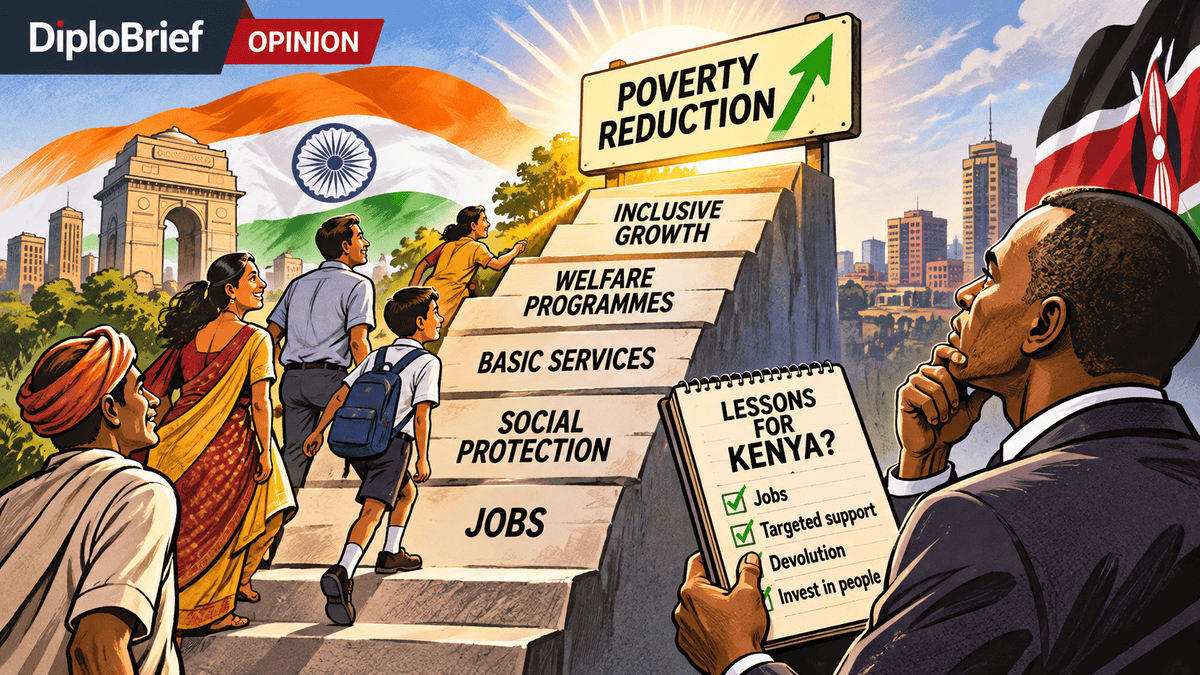
India has been recognized as the global champion of the first Sustainable Development Goal: ending poverty in all its forms everywhere.
In 2015, when the world made a promise at the United Nations to pursue 17 SDG’s, the first and the boldest goal felt so distant. A decade later, India is proving to the world that mass poverty is reversible and mutable.
According to the World Bank, India lifted an estimated 496 million people out of poverty between 2011 and 2023, while extreme poverty fell from 27.1 per cent to 2.6 per cent of the population.
For Kenya, the lesson lies not in India’s model and its strategy cannot be copied wholesale without local context. Kenya is smaller, more exposed to external shocks and constrained by a different fiscal reality.
However, India’s experience demonstrates something Kenyan policymakers should take seriously: poverty falls fastest when economic growth, basic services, and social protection move together.
India’s achievement is extraordinary and inspirational.
Between 2011 and 2023, the share of Indians living below the lower middle-income poverty line of $4.20 a day fell from 57.7 per cent to 16.1 per cent. Extreme poverty, measured at $3.00 a day in 2021 purchasing power parity terms, fell from 27.1 per cent to 2.6 per cent. This is transformation measured in lives.
The only comparable achievement in modern history is China lifting more than 800 million people out of extreme poverty over a period of roughly four decades. India’s decline has occurred in just 12 years, making it the fastest poverty reductions recorded anywhere in the world.
This does not mean India has solved the poverty question as the World Bank estimates that 233 million Indians still live below the lower middle-income poverty line.
But the scale matters because it shows that if a country with more than a billion people, with deep regional inequalities, vast rural populations and persistent administrative challenges can improve the lives of ordinary people dramatically, poverty can be eliminated with sustained government efforts.
The most striking symbol of India’s progress came in November 2025, when the southern state of Kerala became the first Indian state to officially declare itself free from extreme poverty.
Its extreme poverty eradication programme used neighborhood surveys and data, local verification and customized “micro-plans” for more than 64,000 households.
Support focused on immediate needs such as food and healthcare while also creating pathways to secure housing and sustainable livelihoods.
The lesson here is that poverty alleviation is not only about national statistics, but knowing who is being left behind, where they live, what they lack and what specific support will help them stand on their own.
India’s progress did not emerge from one grand policy. It was built through successive governments that launched, preserved and improved welfare programmes. Former Prime Minister Manmohan Singh’s rural employment guarantee, provided at least 100 days of paid work each year to eligible rural households.
Prime Minister Narendra Modi’s administration expanded direct cash transfers, free food rations, housing support and sanitation programmes. These are not glamorous policies. They are basic services like water at the tap, a toilet at home, clean cooking fuel, food security, electricity, accessible and affordable healthcare and a bank account. Yet together they create the foundation for a dignified life.
Kenya in comparison made real progress between 2005 and 2015 and poverty declined steadily, but the momentum has largely stalled. The World Bank estimates that Kenya’s poverty rate reached 43.3 per cent in 2025 at the $3.00 per day international poverty line, falling by two percentage points over the previous three years.
The reasons include high inflation, global energy price shocks, climate vulnerability, weak productivity growth and insufficient formal job creation. The Bank warns that higher fuel prices could push an additional 1 million to 2.4 million Kenyans below the poverty line in 2026.
Youth employment is especially urgent. About 800,000 young people enter the labour market each year, yet the economy creates only about 100,000 formal jobs annually leaving majority of Kenyans in informal and low productivity work that limits how much national growth translates into household income. Kenya has the tools.
Initiatives such as the Inua Jamii cash transfers, the Equalization Fund for marginalized counties and Nyota fund youth empowerment programme have the potential to make a difference if they are scaled, managed more efficiently and sustained over successive governments.
However, rising public debt, estimated at around 69 to 71 per cent of GDP, limits fiscal space for broader subsidies and social protection. Kenya cannot simply spend its way out of poverty. It must design smarter, better targeted and more digitally efficient systems.
For Kenya to succeed, it must prioritise labor-intensive sectors and enhance agro-processing, digital services, manufacturing, housing, infrastructure and small enterprises. These sectors must create incomes for ordinary households and not profits for a few. Second, decentralisation or devolution must become practical, not rhetorical.
Counties are closer to local needs and are better placed to identify vulnerable families, coordinate services and implement anti-poverty programmes. County governments need the capacity, data systems and accountability mechanisms so that devolution delivers results.
Third, social protection must be targeted, digital and adaptive. The country needs a unified beneficiary registry, reliable digital ID integration and interoperable payment systems. This would reduce leakage, lower administrative costs and allow support to reach those who need it most during shocks.
Finally, Kenya must invest in its people. Education, health, nutrition, skills, apprenticeships and affordable healthcare are not social expenses; they are the country’s most productive long-term investments.
A young population can become Kenya’s greatest asset or its greatest risk, depending on whether opportunity reaches it.
With political will, efficient delivery, inclusive growth and sustained investment in human dignity, millions can move from survival to possibility. India is an inspiring example.
The Author is a geopolitical analyst and Executive Director at Research and Engagement Africa (REA) think tank.